
A Majority Majority: What the 2025 North Dakota Public Health Legislative Scorecard Found
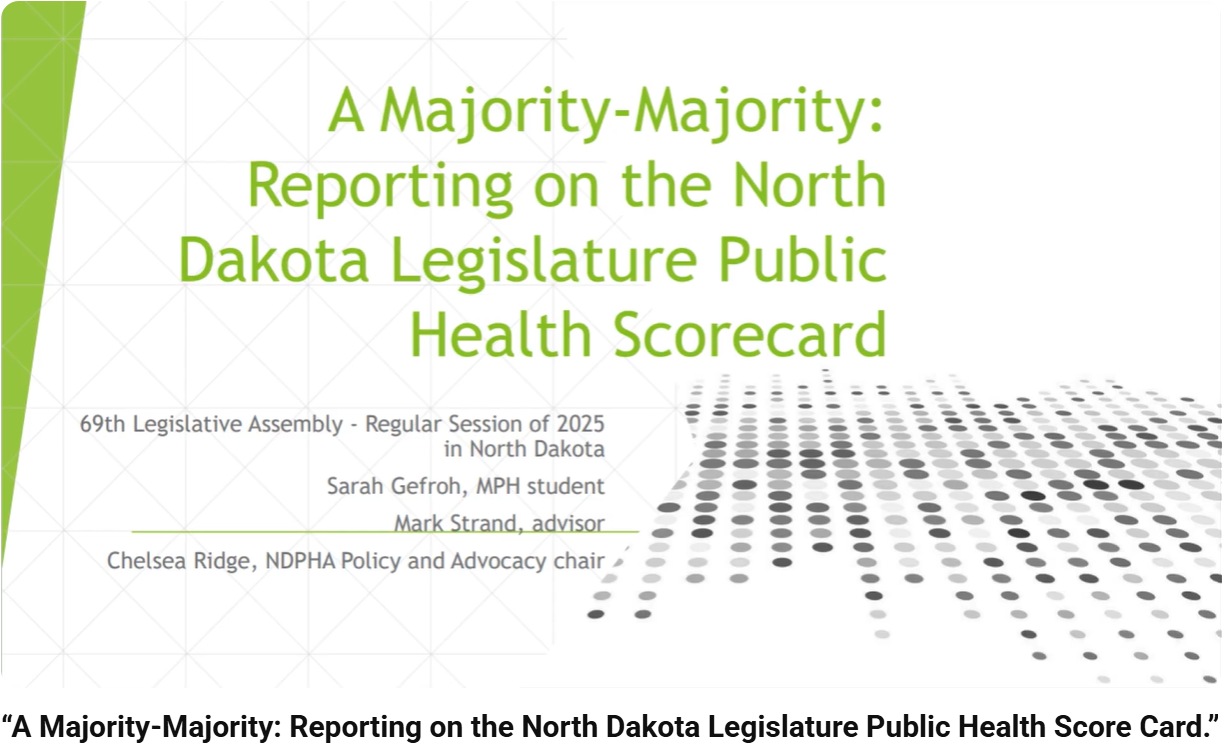
Lydia DeJesus, member of the Vision West North Dakota administrative team, attended a recent public health session hosted by NDSU and the North Dakota Public Health Association. The session, titled A Majority Majority: Reporting on the North Dakota Legislature Public Health Scorecard, offered a grounded look at how lawmakers voted on a set of public health-related bills and how that information can be used to strengthen civic engagement.
The Scorecard Is Not a Weapon. It Is a Map.
Most people talk about the legislature as if it were a locked room.
A place where decisions happen far away, behind language you do not speak, shaped by people you will never meet.
This presentation quietly overturned that myth.
What the North Dakota Public Health Association shared was not just a set of numbers. It was a simple, repeatable way to see how public health lives inside votes. Then to use that visibility to build relationships, educate where understanding is thin, and advocate without turning the work into a brawl.
What the scorecard is for
The presenters named the purpose plainly.
This scorecard exists to understand positions and to decide where education and advocacy are needed. It is intended to support conversation and potential collaboration with legislators who hold different views on public health bills. It is not designed to punish. It is not designed to pick fights.
That framing matters because public health is already operating in a climate where trust is fragile. If the tool is perceived as a hit list, it fails before it starts. The association is trying to build durable civic muscle, not momentary outrage.
What surprised them most
One of the most useful moments in the presentation was not a chart. It was a confession.
Sarah, who helped run the process, said it was easier than she imagined, figuring out who represents you and monitoring bills as they move through the system. She described the process as doable, not intimidating, and urged people not to be discouraged.
This is the hidden value for students, community members, and early-career public health professionals.
You do not have to be an insider to watch what is happening.
You only need to start watching.
How it was built, in human terms
Here is the short version of what they did, translated into plain language.
Members submitted bills they believed mattered to public health. That list grew to more than 40. A committee of ten public health experts then reviewed the list, categorized bills as supportive or opposed to public health, and removed any bill for which they could not reach consensus. The final set included 26 bills.
Then they recorded how every legislator voted on those bills and calculated an alignment score for each person, based on the percentage of votes that matched the public health position assigned to each bill.
They also emphasized the source of the information. The North Dakota Legislative website, where anyone can look up legislators, locate bills, and view roll call votes.
This is the point.
The scorecard is not magic. It is organized attention.
What it found, and why the headline matters
The presentation title, “A Majority Majority,” was not rhetorical.
Their key finding was that more than half of legislators supported more than half of the public health bills they tracked. The number shared was 72 of 141 legislators, or 51.1 percent.
That matters because it changes the emotional story many advocates carry.
If you assume the legislature is mostly hostile to public health, you will either burn out or posture for war.
If you accept the “majority majority” finding, you can work differently.
You can treat advocacy as a relationship, education, and precision targeting, instead of a constant crisis.
The chamber divide is real
They showed that senators supported public health measures more often than members of the House of Representatives.
And they paired that with a sobering detail. In their summary, 87.2 percent of senators supported at least half of the public health bills, compared with 33.0 percent of representatives.
If you are trying to move a policy, that difference is not trivial. It tells you where friction is more likely to show up and where education and relationship-building may need to start earlier.
Tenure, term limits, and the coming wave of education work
Another finding was simple and consequential.
Legislators who had served before were more likely to vote in alignment with public health than new legislators.
The presenters connected this to a deeper truth about public health. Much of what public health protects is slow, cumulative, and invisible when it is working. When people do not see harm, they assume protection is unnecessary.
They also cited term limits as a factor that may increase turnover, suggesting the education problem does not shrink over time. It grows.
For the intended audience, this is the practical message.
The work is to persuade. The work is to teach what public health means.
Over and over again.
“Health freedom” as a predictor of lower public health support
The presentation also surfaced a values story that can help advocates avoid naive messaging.
They described “health freedom” as the principle that individuals should be able to decide what they do with their own health, citing examples such as vaccines, seatbelts, and raw milk. They acknowledged that personal responsibility has an admirable edge, while also emphasizing that government remains accountable for the welfare of the people.
Then they showed an association: legislators described as health freedom advocates scored substantially lower in public health support than those who were not.
For anyone trying to build public will, that is strategic intelligence.
It suggests you cannot speak only in the language of evidence. You also need to speak in the language of values, responsibility, and the shared costs of individual risk.
The bills were not just examples. They were a lesson in persuasion
The presentation used several bills to illustrate why public health voting is not always a simple party story. Some bills passed with strong support, including items like tribal health care coordination through the Department of Health and Human Services, septic system permitting and inspection, and decriminalizing HIV transmission.
The proposed legislation reveals the tension between competing values, particularly regarding long-term prevention, corporate interests, and marginalized communities. Each bill serves as a critical opportunity to engage in meaningful dialogue with both your neighbors and legislators. Consider the lens through which you will frame your arguments: Will you emphasize freedom, responsibility, financial implications, family well-being, workforce vitality, rural practicality, or community safety?
What to do with the scorecard if you are not “equipped.”
A question in the Q&A asked about actionable steps for students and community members who feel overshadowed by dominant voices in public health. The response was both practical and empowering:
Join Forces with Local Organizations: Becoming part of a reputable organization can amplify your voice and broaden your impact.
Leverage Existing Coordination Efforts: Tap into established networks to maximize your reach and effectiveness in advocating for change.
Engage Boldly and Confidently: Step into these spaces with assurance. Your perspective is valuable, and participation is key to driving meaningful dialogue.
By implementing these strategies, you can effectively assert your influence and amplify your voice within the public health discourse. Additionally, they addressed a critical follow-up regarding NDPHA's engagement with legislators who have low public health alignment scores. Their position is clear: members are equipped to engage with all legislators, not solely those who are supportive. The focus is on cultivating relationships and fostering mutual understanding. They provided compelling examples of informal engagement, such as hosting a legislator reception and facilitating one-on-one conversations, demonstrating their commitment to building connections.
The real value
This scorecard delivers impactful insights:
Demonstrates that legislative engagement is accessible to all, breaking down barriers traditionally reserved for insiders.
Provides a comprehensive overview of where public health support thrives and where it encounters challenges.
Highlights education as a vital strategy, particularly for connecting with new legislators and navigating potential turnover.
Equips you with a values-based framework that enhances communication across divides, especially when "health freedom" serves as a key identity marker.
A posture for advocacy that is constructive, relationship-focused, and built for the long game
The scorecard is not the work itself; it is a powerful tool that brings clarity to efforts. When public health becomes clear and measurable, it ceases to be abstract and becomes something that cannot be easily dismissed.
To watch the full presentation and hear the findings in the presenters’ own words, view the recording on the NDSU College of Health and Human Sciences YouTube channel.